-->
Showing posts with label Playing With Gears. Show all posts

Wednesday, July 17, 2013

Placing and Fitting Gears


LEGO Mindstorms NXT hobbyist, how are you? I hope you is still motivated for following my posting. Lets We learning about gears again.It is continue topic before, about Limiting Strength with Clutch Gear. The LEGO gear set includes many different types of gear wheels. Up to now, we played
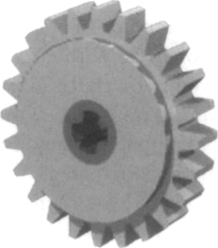
with the straight 8t, 24t, and 40t, but the time has come to explore other kinds of gears, and to discuss their use according to size and shape. In studless buildings, unlike traditional studded building, the holes in TECHNIC beams stacked atop one another are the same distance apart as holes in a single beam. This means gears connected together will be the same number of holes apart, whether connected horizontally along the same beam or vertically across multiple beams (see Figure
2.7 and Figure 2.8).

Figure 2.7 Vertical Matching of Gears


Figure 2.8 Matching gears horizontally and vertically

Tuesday, July 2, 2013

Limiting Strength with the Clutch Gear

LEGO Mindstorms NXT hobbyist, This topic is continue our topic about playing with gear: worm gear. Another special device LEGO Mindstorms NXT hobbyist should get familiar with is the thick 24t white gear, which has strange markings on its face (Figure 2.5). It is a clutch gear, and in the next part of this section we'll discover just what it does.

Figure 2.5 The Clutch Gear

Saturday, June 29, 2013

Worming Your Way: The Worm Gear

LEGO Mindstorms NXT hobbiyst, Do you remember about the geartrain in the past my posting?
This posting, I dont review it.  We will learn about the worm gear. Do you know the worm gear? In your NXT box, you've probably found another strange gear, a black one that resembles a sort of cylinder with a spiral wound around it. It is called worm gear. Is this thing really a gear? Yes, it is, but it is so peculiar we have to give it special mention.

In Figure 2.4, you can see a worm gear engaged with more familiar gears. The assembly on the right uses a special LEGO part. It is called a worm gear block. With this single piece you can connect the worm gear to a 24t gear. In just building these simple assemblies, you will discover many properties. Try to turn the axles by hand. Notice that although you can easily turn the axle connected to the worm gear, you can't turn the one attached to the other gears. We have discovered the first important property: The worm gear leads to an asymmetrical system; that is, you can use it to turn other gears, but it can't be turned by other gears.The reason for this asymmetry is, once again, friction. Is this a bad thing? Not necessarily. It can be used for other purposes.

Figure 2.4 Worm Gears Engaged with Other Gears

Monday, June 24, 2013

Riding That Train: The Geartrain

LEGO Mindstorms NXT hobbyist, Before... we have learn about Gearing up and down. All right.. we continue to learning about gears. The largest LEGO gear is the 40t, and the smallest is the 8t (used in the previous discussion). Thus, the highest ratio we can obtain is 8:40, or 1:5 (Figure 2.2).

Figure 2.2 A 1"5 Gear Ratio
 

Sunday, June 23, 2013

Gearing Up and Down

LEGO Mindstorms NXT hobbyist, do you remember to counting teeth of gear in the past my posting? Now, lets we continue to learning about gearing up and down. Let's start turning the larger gear in our example. It has 24 teeth, each one meshing perfectly between two teeth of the 8t gear. While turning the 24t, every time a new tooth takes the place of the previous one in the contact area of the gears, the 8t gear turns exactly one tooth too. The key point here is that you need to advance only eight teeth of the 24 to make the small gear do a complete turn (360 degrees). After eight teeth more of your 24, the small gear has made a second revolution. With the last eight teeth of your 24, the 8t gear makes its third turn. This is why there is a difference in speed: For every turn of the 24t, the 8t makes three turns! We express this relationship with a ratio that contains the number of teeth in both gears: 24 to 8. We can simplify it, dividing the two terms by the smaller of the two (8), so we get 3 to 1. This makes it very clear in numerical terms that one turn of the first corresponds to three turns of the second.

You have just found a way to get more speed! (To be technically precise, we should call it angular velocity, not speed, but you get the idea.) Before you start imagining mammoth gear ratios for race car robots of LEGO Mindstorms NXT, sorry to disappoint you~there is no free lunch in mechanics; you have to pay for this gained speed.You pay for it with a decrease in torque, or, to keep in simple terms, a decrease in strength.

Friday, June 21, 2013

Playing With Gears

Hello world! Hello LEGO Mindstorms NXT hobbyist! Now, We will learn about playing with gears. You might find yourself asking "Do I really need gears?" Well, the answer is yes, you do. Gears are so important for machines that they are almost their symbol: Just the sight of a gear makes you think machinery. In this posting you will enter the amazing world of gears and discover the powerful qualities they offer, transforming one force into another almost magically. We'll guide you through some new concepts~velocity, force, torque, friction~as well as some simple math to lay the foundations that will give you the most from the machinery. The concepts are not as complex as you might think. For instance, the posting will help you see the parallels between gears and simple levers.
 
LEGO Mindstorms NXT hobbyist, are you ready? We invite you once again to experiment with the real things. Prepare some gears, beams, and ames to replicate the simple setups of this posting. No description or explanation can replace what you learn through hands-on experience.